
Théo Mercier - Fossil Opera
Fossil Opera
Le Voyage à Nantes – Place Graslin, Nantes, France
July 4 – September 6 2026
In the late-18th century, Jean-Joseph-Louis Graslin, agricultural tax collector for the kingdom, sought to create a new district on a hill west of the city, overlooking the port. He entrusted the project to Mathurin Crucy, Nantes’official architect and surveyor, who was tasked with designing both the neighbourhood and the theatre that would form its centrepiece. The resulting semicircular square was designed to mirror the theatre itself: from the balconies of the surrounding buildings, residents could admire the spectacle of the city; from the theatre balconies, they could enjoy the spectacle of humanity. It was a defining act: taming raw material, then replacing it with carved stone and neoclassical order. With Fossil Opera, Théo Mercier reopens this “tamed” ground – not to erase Graslin’s work, but to bring to light what it had concealed.
As a proudly self-taught artist, Mercier has developed a body of work that resists easy categorization, where he mixes sculpture, performance, scenography, and in situ installations. What unites all of his practice is an obsession with matter in transformation: objects that mutate, waste that becomes an organism, and architecture that breathes. He approaches sculpture as might a stage director –!and stage direction as might a sculptor. Drawing on anthropology, geopolitics, and collective memory to create works that hover between the animate and the inanimate, the static and the mobile, his visual fictions allow past and present to erode one another, often with a touch of humour and the uncanny.
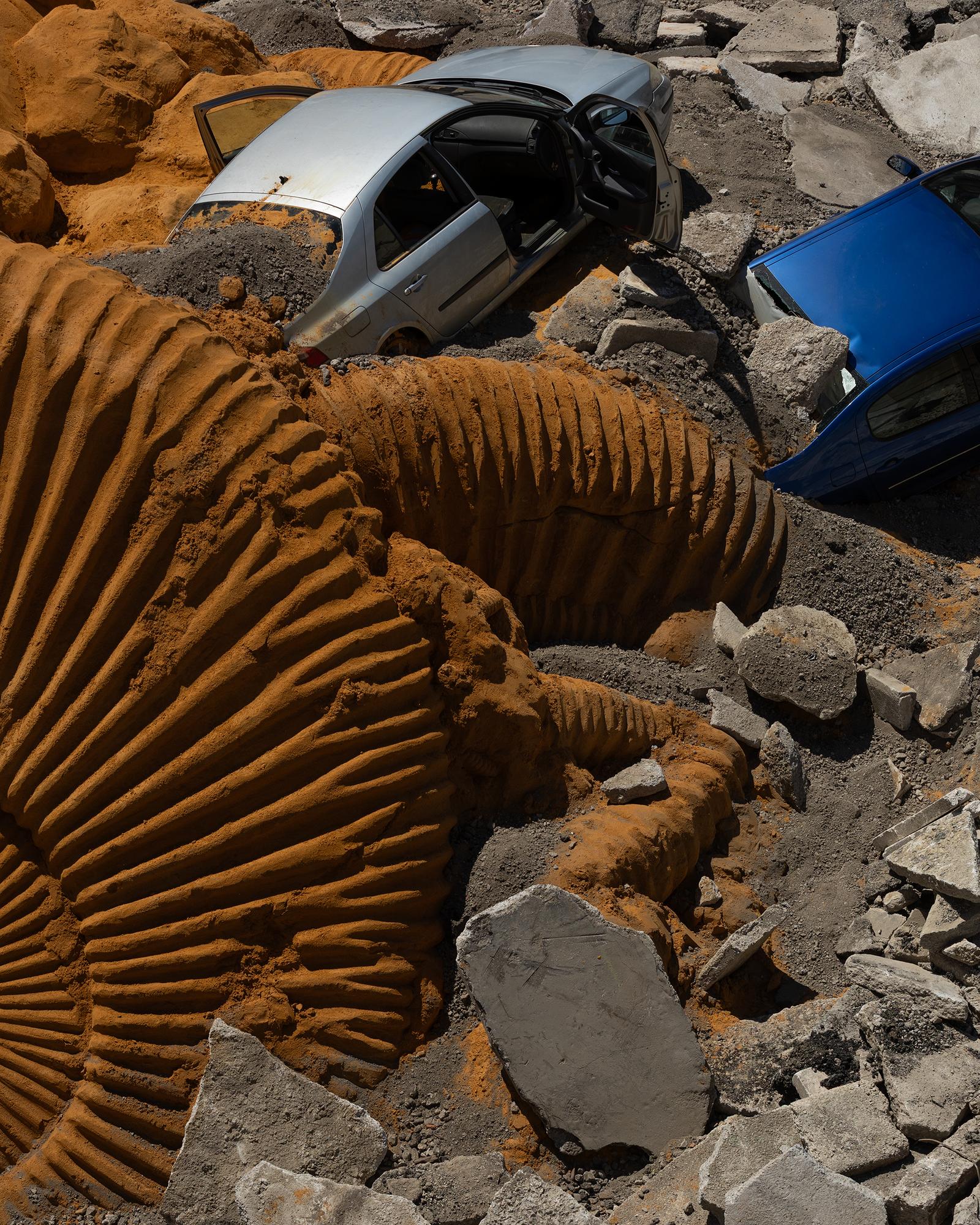
For Place Graslin, Mercier works with sand: a material that has been central to his sculptural practice for years, and which he uses outdoors here for the first time. On the forecourt outside the opera house, he orchestrates a slow, telluric eruption: the ground appears to split open, allowing a wave of compacted and sculpted sand in the form of giant ammonites to rise from the depths of the square, reaching heights of up to 4.4 metres (14.5 ft.). The surface is transformed, now existing somewhere between an earthquake and a dream. As if lifted by this subterranean pulse, what had been buried suddenly resurfaces: rubble taken from construction sites across Nantes, and mute witnesses to the city’s constant transformation; half-buried cars, remnants of the recent past when this now pedestrian-only square was still subject to traffic.
For the space of a summer, this square becomes soil itself: a place of possibilities, births and revolutions; a site of burial and emergence, upheaval, landslides and tremors. This surging matter is answered by another force: sound. Each car plays its own score, drifting from within its cabin, as if counterbalancing the violent eruption of the seismic event. It is as though opera were reclaiming its place amid the chaos. The vehicles become performers in this open-air composition – living witnesses to operas replaying across the square. Fossil Opera thus becomes both stage and sculpture. In its own way, the installation reenacts Place Graslin’s original vocation: that of being dedicated to the performing arts. It composes a dizzying stratigraphy in which the sand of our constructions, the debris of our demolitions, and the cars of our modern age lie buried together before being brought back to daylight.
Faithful to the artist’s approach, Fossil Opera merely borrows matter temporarily: the sand comes from regional quarries, the rubble from city construction sites, and the cars from a Nantes repair shop. At the end of the event, each element will return to its original source, as though the installation had been only a brief parenthesis in the ongoing cycle of Nantes’ transformations.