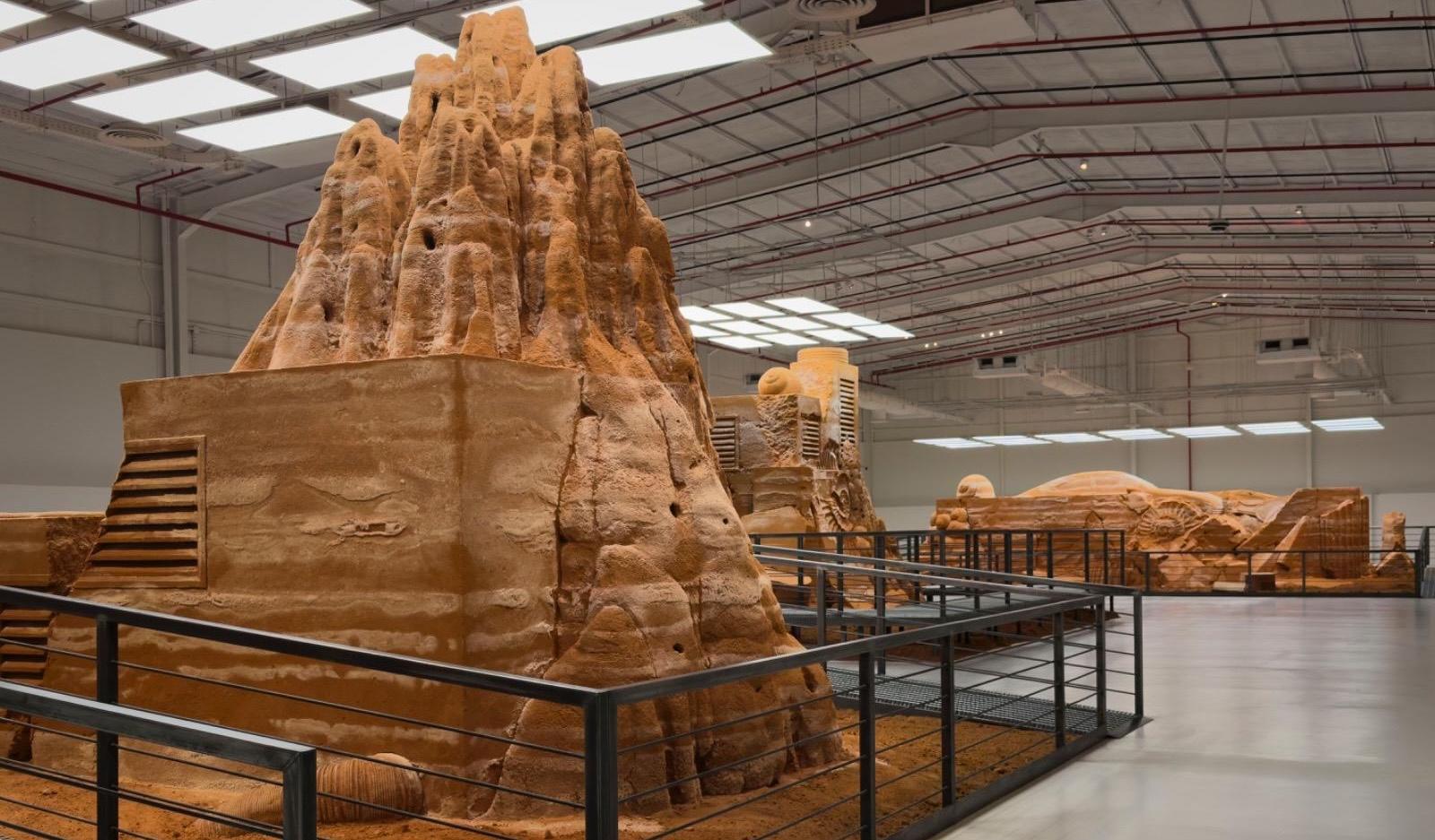
“House of Eternity” is a fictional extraction site sculpted from 250 tons of sand and water from Saudi Arabia. Brought together in this ephemeral form during the 2026 Diriyah Contemporary Art Biennial, sand and salt play the leading roles in this “soil fiction.” Both resources and allegories of the world in metamorphosis, they are also the driving force behind a circular economy based on borrowing materials, which Théo Mercier has been developing since 2021.
In the gallery space, four sculpted monoliths surrounded by archaeological-like walkways offer visitors the experience of an illogical history of time. To discover them is to study the theory of evolution in reverse, and understand the beauty and the glitch that creep into the lineage of all living archaic and industrial fossils. How does the ammonite become a shell, an ear, an helix, a ventilator, a wheel that sets the globe in infinite transformation? This ambiguous territory, whose unstable appearance constantly shifts between a data center, an industrial factory, a bunker, or even a palace of memory, is nothing less than a breathing machine designed to dismantle linear time. To the idea that it seems easier to imagine the end of capitalism than the end of the world, Mercier counters with a futuristic scenario in which ruinism and capitalism have finally merged into the substance of a deep earth, a dormant habitat for new forms of life.
In this soil fiction where we suddenly witness a crystallization of a boiling, eruptive, multi-layered memory, the sand takes on a new dimension: as an elementary particle and cellular memory of the world, the grain is here the unit of all things. It is the atom, the bit, the pixel, the molecule as well as the code of a matrix whose memory is eternally formed and deformed.